
The Federal Act on the Transparency of Legal Entities (LTPM), adopted on 26 September 2025, enters into force in the second half of 2026. Approximately 600,000 Swiss companies — Ltd (SA), LLC (Sàrl), cooperatives — as well as certain foreign entities will be required to declare their beneficial owners to a new federal register. Fines of up to CHF 500,000, deadlines of 3 to 6 months, possible dissolution in case of non-compliance: here is what you need to know and do.
Contents
- The LTPM in 2 minutes: the essentials for directors
- Checklist: 10 steps to prepare
- The 5 most common mistakes we see
- Transitional deadlines: which one applies to you?
- 3 practical examples: family LLC, holding, foreign company
- Who is covered, who is exempt?
- What is a beneficial owner under the LTPM?
- Detailed obligations (companies, shareholders, trusts)
- The register: how it works, access and discrepancy reports
- Penalties: what you actually risk
- How much time and money does it cost?
- How My Swiss Company can help
- FAQ
- Sources
The LTPM in 2 minutes: the essentials for directors
If you are a director of a non-listed Swiss Ltd (SA) or LLC (Sàrl), you will need to disclose to the federal government who truly owns your company. This is the core of the LTPM.
| Question | Answer |
|---|---|
| What? | A federal register where each company declares its beneficial owners — the natural persons who hold ≥ 25% of the share capital/voting rights or who control the company by other means |
| Who? | All Ltd (SA), LLC (Sàrl), cooperatives, SICAV, SICAF + foreign entities with a branch, effective management or real estate in Switzerland. Approx. 600,000 entities |
| When? | Entry into force: second half of 2026. Transitional deadlines: 3 to 6 months (or 2 years if all beneficial owners are already registered at the Commercial Register) |
| Where? | Online filing via EasyGov.swiss or through the cantonal Commercial Register office |
| Cost? | Registration is free (Art. 41 LTPM). It is the data preparation and ownership structure mapping that require time |
| Penalties? | Up to CHF 500,000 fine (Art. 43 LTPM). Suspension of shareholder rights and possible dissolution for repeated breaches |
| Public? | No. The register is only accessible to authorities (police, MROS, tax authorities, FINMA) and financial intermediaries subject to the AMLA |
Source: LTPM (FF 2025 2900), adopted 26 September 2025
The rest of this article details what you need to do, in what order, and the pitfalls to avoid.
Checklist: 10 steps to prepare for the LTPM
Here are the practical steps to take now, in logical order:
- Check whether you are subject to the law — is your legal form covered by Art. 2 LTPM? If you have recently incorporated a company in Switzerland, the deadline runs from the Commercial Register entry. Do you qualify for an exemption (listed company, subsidiary > 75%-owned by a listed entity, public body)?
- Map your ownership structure — trace all chains of participation down to the natural persons. Who holds the shares, through which intermediary entities?
- Identify your beneficial owners — who holds ≥ 25% of share capital or voting rights? Who exercises control by other means (shareholders’ agreement, power of attorney, articles of association)?
- Collect the 5 mandatory data points — for each beneficial owner: first and last name, date of birth, nationality, address and country of residence, nature and extent of control exercised.
- Verify their identity — request supporting documents: passport/ID copy, register extract, ownership chain organisation chart.
- Document everything — record all information and steps taken, including any inability to identify a beneficial owner. Mandatory retention: 10 years after the person ceases to be a beneficial owner.
- Register on EasyGov.swiss — account validation takes several days. Do it now.
- Determine your transitional deadline — 3, 4, 5, 6 months or 2 years depending on your category (see table below). Set a reminder.
- Establish an update process — every change (share transfer, new director, restructuring) must be reported to the register within one month.
- Engage a Corporate Services Provider if needed — Art. 12(2) LTPM expressly allows delegation. The director remains responsible, but the professional does the work.
My Swiss Company’s Advice
Start with steps 1 to 3. If your structure is straightforward (LLC with 2–3 shareholders, all registered at the Commercial Register), you can prepare the filing yourself. If your structure involves a holding company, foreign shareholders or a trust, seek professional assistance: mapping the chain of control is rarely straightforward in these cases.
The 5 most common mistakes we see
In preparing our clients for LTPM compliance, we consistently encounter the same issues. Identifying them now avoids bottlenecks on filing day.
1. Confusing the registered shareholder with the beneficial owner
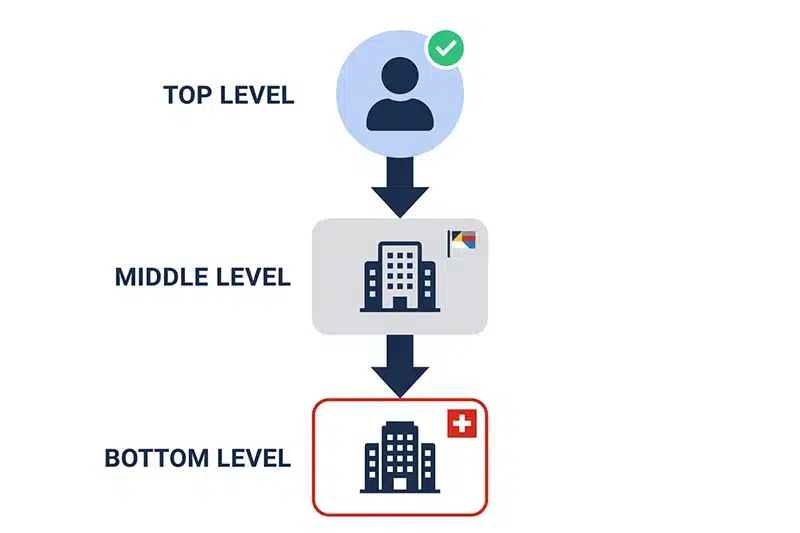
The Commercial Register shows who is an officer or shareholder of the company. The beneficial owner is the natural person who exercises ultimate control. If a Luxembourg holding company owns 100% of your LLC (Sàrl), the registered shareholder is the holding — but the beneficial owner is the natural person behind it. The LTPM requires tracing the entire chain.
2. Overlooking “control by other means”
The LTPM goes beyond the 25% capital or voting threshold. A person who exercises control through a shareholders’ agreement, veto clause, general power of attorney or fiduciary arrangement is also a beneficial owner, even if they hold no shares. In our experience, this is the most poorly documented scenario.
3. Not having the supporting documents
Identifying the beneficial owner is not enough: their identity must be verified with due diligence (Art. 7(2) LTPM) and documents must be kept for 10 years. We regularly see companies that know their shareholders perfectly well but have never requested a passport copy or certified organisation chart. On filing day, they are stuck — especially when the shareholder is based abroad and does not respond within 48 hours.
4. Forgetting the early trigger
Even if your transitional deadline is 6 months or 2 years, any change at the Commercial Register before the deadline (change of director, capital increase, relocation of registered office) triggers a one-month deadline for the LTPM filing (Art. 51(1)). If you are planning a Commercial Register amendment in the coming months, prepare the LTPM filing in parallel.
5. Assuming “it’s the same as before”
The previous regime (Art. 697j–697m CO) required a private, company-internal register. The LTPM is fundamentally different: data is submitted to a federal register, overseen by a dedicated authority within the FDF, with risk-based audits and a discrepancy reporting mechanism involving banks. This is a step change, not an adjustment.
Transitional deadlines: which one applies to you?
The deadline for making the first filing depends on your type of company and audit obligation. Identify your category in this table (Art. 51–53 LTPM):
| Your situation | Deadline from entry into force |
|---|---|
| New company (incorporated after entry into force) | 1 month after Commercial Register entry |
| Existing company — all beneficial owners already registered at the CR as shareholders or officers | 2 years (simplified filing via CR possible, Art. 11) |
| Ltd (SA) subject to ordinary audit | 3 months |
| Other company subject to ordinary audit | 4 months |
| Ltd (SA) not subject to ordinary audit | 5 months |
| Other company not subject to limited audit / other legal entity | 6 months |
| Foreign legal entity | 6 months |
Source: Art. 51–53 LTPM
Important — the early trigger
Any change at the Commercial Register before your transitional deadline expires triggers a one-month deadline for the LTPM filing (Art. 51(1)). The cantonal CR office will inform you of this obligation at the time of your first post-entry-into-force amendment.
3 practical examples of LTPM compliance support
Here are three typical scenarios we handle at My Swiss Company, with the specific steps for each:
| Profile | Situation | What we do | Deadline |
|---|---|---|---|
| Family LLC in Zug (3 shareholders, all at CR) |
Simple structure: all 3 shareholders are the beneficial owners and are already registered at the Commercial Register | Simplified filing via the cantonal CR office (Art. 11 LTPM). Collection of ID documents. Confirmation that no other beneficial owner exists. | 2 years max |
| Holding Ltd in Geneva (Luxembourg corporate shareholder, 40%) |
One shareholder is a Luxembourg legal entity. The beneficial owner is the natural person behind that entity — the chain must be traced. | Mapping of the indirect chain of control. Document requests to Luxembourg (passport, organisation chart, register extract). Filing via EasyGov with chain documentation. | 3 to 5 months |
| UK Limited (effective management in Lucerne + real estate) |
English law company managed from Switzerland, owning commercial real estate | Dual obligation: transparency register filing + list of holders (Art. 18). Designation of MSC as representative in Switzerland (Art. 17(2)). Coordination with the Land Register (Art. 40). | 6 months |
Typical scenarios — My Swiss Company SA, Geneva / Lucerne / Zug
Who is covered, who is exempt?
All non-listed Ltd (SA), LLC (Sàrl), cooperatives, SICAV, SICAF and limited partnerships for collective investment are subject to the LTPM (Art. 2). Foreign legal entities with a branch in Switzerland, effective management in Switzerland or real estate in Switzerland are also covered.
Exemptions (Art. 3 LTPM)
- Listed companies and their subsidiaries held at more than 75%.
- Occupational pension institutions (LPP/BVG).
- Legal entities held at 75%+ by public bodies.
Associations, foundations and sole proprietorships fall outside the scope — an exclusion secured during parliamentary debate.
What is a beneficial owner under the LTPM?
The beneficial owner is the natural person who ultimately controls a company, by holding at least 25% of the share capital or voting rights, or by exercising control by other means (Art. 4 LTPM).
“Ultimately” is the key: all intermediary entities (holding companies, sub-holdings, trusts, fiduciary arrangements) must be traced through to the final natural person. If no person meets these criteria, the most senior member of the management body is declared by default (Art. 4(2)).
The concept of “control by other means” will be detailed in the implementing ordinance (OTPM), but it encompasses shareholders’ agreements, veto clauses, powers of attorney and fiduciary structures.
Detailed obligations: companies, shareholders and trusts
Company obligations (Art. 7–12 LTPM)
Each company subject to the LTPM must: (1) identify its beneficial owners and collect 5 data points (name, date of birth, nationality, address, nature of control), (2) verify their identity with due diligence, (3) document and retain the information for 10 years, accessible at all times in Switzerland, (4) file with the transparency register within the prescribed deadline. The most senior director is responsible for the filings, even if delegated (Art. 12).
Obligations of shareholders and beneficial owners (Art. 13–14 LTPM)
Any shareholder holding a controlling stake must notify the company of the beneficial owner’s identity within one month. The beneficial owner must self-report when acquiring that status. These obligations are reciprocal — the company relies on the shareholder, who relies on the beneficial owner’s self-declaration.
Trusts (Art. 15–16 LTPM)
Trustees domiciled in Switzerland or administering trusts from Switzerland (unless already subject to the AMLA) must identify all beneficial owners of the trust: settlor, trustee, protector, beneficiaries and any person controlling the trust. Retention: 5 years after the end of the trustee’s mandate. The information is held by the trustee — it is not entered in the transparency register.
My Swiss Company’s Advice
For discretionary trusts, the trustee must document the criteria that determine beneficiary status — not just the names of current beneficiaries. This is a technical point often overlooked.
The register: how it works, access and discrepancy reports
The transparency register is maintained electronically by the Federal Office of Justice (Art. 20 LTPM). It is not public.
Who can access it? Police, criminal prosecution and administrative authorities, MROS, tax authorities, SECO, FINMA, the Intelligence Service (Art. 25–26). Financial intermediaries subject to the AMLA may also consult it for their due diligence obligations (Art. 27). Every access is logged.
Discrepancy reports: if a bank or authority finds that the register data does not match its own information, it must report the discrepancy (Art. 30–31). The register annotates the entry and orders the entity to correct it. These reports may trigger controls by the FDF’s supervisory authority (Art. 35–39), which operates on a risk-based approach.
Declaratory entries: entries have no constitutive effect (Art. 23). Financial intermediaries cannot rely solely on the register for their AMLA obligations — but they may rely on it in the absence of any anomaly.
Penalties: what you actually risk
The LTPM carries significant penalties, designed to deter inaction.
| Offence | Penalty | Legal basis |
|---|---|---|
| Intentional breach of filing obligations | Fine up to CHF 500,000 | Art. 43 LTPM |
| False information to the supervisory authority | Fine up to CHF 500,000 | Art. 43(c) |
| Non-compliance with a binding decision | Fine up to CHF 100,000 | Art. 44 LTPM |
| Repeated breaches not remedied | Suspension of shareholder rights | Art. 38(2) |
| Repeated breaches + no activity/assets | Dissolution and liquidation | Art. 38(3) |
| Foreign entity — repeated breaches | Deregistration of the branch | Art. 38(3)(b) |
Limitation period: 7 years (Art. 45(4)). Prosecution: ACLA, FDF jurisdiction.
The key word is “intentionally”. The law does not punish good-faith errors — it targets deliberate violations or systematic non-cooperation. However, an omission lasting 6 months without correction after a formal reminder starts to look very much like intent.
How much time and money does it cost?
Registration is free (Art. 41 LTPM). What costs time — and potentially money — is the preparation:
| Type of structure | Estimated workload | Professional support |
|---|---|---|
| Simple structure (LLC, 2–3 shareholders at CR) |
A few hours: collect ID documents, register on EasyGov, file | Optional — manageable in-house |
| Intermediate structure (Ltd with foreign corporate shareholder or simple holding) |
1 to 3 days: mapping, document requests abroad, documentation | Recommended |
| Complex structure (multi-level holding, trust, indirect multi-jurisdictional control) |
1 to 3 weeks: legal analysis, international coordination, comprehensive documentation | Essential |
Estimates based on our experience — My Swiss Company SA
The recurring impact: every change in your structure (share transfer, new director, restructuring) must be reported within one month. Without an internal process to detect changes, delays accumulate.
How My Swiss Company can help
My Swiss Company SA, a Swiss Corporate Services Provider with offices in Geneva, Lucerne and Zug, supports over 300 Swiss and international companies. Our director, Andrés Taracido, holds the TEP designation (Trust and Estate Practitioner) — directly relevant to the analysis of control chains and fiduciary structures under the LTPM.
- Structure audit — mapping the ownership chain and identifying all beneficial owners. Particularly useful if you already have a Swiss resident director mandate with us.
- Collection and verification — requesting and archiving supporting documents (10-year retention).
- Register filing — preparation and submission via EasyGov or via the CR in the cantons of Geneva, Lucerne and Zug.
- Ongoing monitoring — tracking changes and filing updates within one month, integrated into our corporate administration services.
- Representation of foreign entities — designation of MSC as representative or notification domicile in Switzerland (Art. 17(2)).
Contact us for a preparatory audit. Mapping a multi-level structure with foreign shareholders typically takes 2 to 3 weeks.
FAQ: Swiss Transparency Register and LTPM
Who is subject to the Swiss transparency register?
The Swiss transparency register covers approximately 600,000 entities: all non-listed Ltd (SA), LLC (Sàrl), cooperatives, SICAV and SICAF, as well as foreign legal entities with a branch, effective management or real estate in Switzerland (Art. 2 LTPM).
Associations, foundations, sole proprietorships and subsidiaries of listed companies held at > 75% are exempt (Art. 3). My Swiss Company SA helps its clients determine whether they fall within scope.
What information must be declared to the transparency register?
Each company must declare five data points per beneficial owner: first and last name, date of birth, nationality, municipality of residence and country of residence, nature and extent of control exercised (Art. 9(1) LTPM).
If the beneficial owner could not be identified despite due diligence efforts, the company must report the name of the most senior director (Art. 9(3)).
When does the LTPM enter into force?
The LTPM enters into force in the second half of 2026. Transitional deadlines range from 3 months for Ltd (SA) subject to ordinary audit to 2 years for companies whose beneficial owners are all already registered at the Commercial Register.
Registration on EasyGov.swiss is already available. My Swiss Company SA recommends registering now, as account validation takes several days.
Is registration in the transparency register free?
Registration in the Swiss transparency register is free, as are amendments and deletions (Art. 41(1) LTPM). Only reminders, formal demands and extracts are subject to fees.
The real cost lies in preparation: mapping the ownership structure, collecting supporting documents and documentation. My Swiss Company SA offers comprehensive support.
What are the penalties for non-compliance with the LTPM?
Intentional breach of the filing obligations is punishable by a fine of up to CHF 500,000 (Art. 43 LTPM). The limitation period is 7 years.
For repeated breaches, the supervisory authority may suspend shareholder rights or order the dissolution of the company (Art. 38). My Swiss Company SA supports its clients in securing compliance.
Can a Corporate Services Provider file on behalf of the company?
The LTPM expressly allows delegation of the filing to a third party, including a Corporate Services Provider (Art. 12(2)). The most senior director remains responsible for proper execution.
My Swiss Company SA, a Swiss Corporate Services Provider with offices in Geneva, Lucerne and Zug, offers this service: beneficial owner identification, document collection, EasyGov filing and ongoing monitoring.
Is the Swiss transparency register accessible to the public?
The Swiss transparency register is not accessible to the public. Only competent authorities (police, public prosecutors, MROS, tax authorities, FINMA) and financial intermediaries subject to the AMLA may consult it online (Art. 25–27 LTPM).
Each entity may request an extract of its own data (Art. 28). My Swiss Company SA can obtain this extract on behalf of its clients.
Are foreign companies subject to the LTPM?
Foreign companies are subject to the LTPM in three cases: branch registered at the Swiss Commercial Register, effective management in Switzerland, or ownership of real estate in Switzerland (Art. 2(1)(b)).
They have a 6-month deadline and must appoint a representative in Switzerland. My Swiss Company SA can be designated as representative or notification domicile.
What is a beneficial owner under the LTPM?
A beneficial owner is the natural person who ultimately controls a company, by holding directly or indirectly at least 25% of the share capital or voting rights, or by exercising control by other means (Art. 4 LTPM).
If no person meets these criteria, the most senior director is declared by default. My Swiss Company SA carries out the chain-of-control analysis for its clients.
How to file with the transparency register via EasyGov?
Filing is done electronically on EasyGov.swiss (Art. 22 LTPM). Pre-registration is recommended now as account validation takes several days.
Companies whose beneficial owners are all already at the Commercial Register may alternatively file through the cantonal CR office (Art. 11). My Swiss Company SA assists its clients with both procedures.
Sources
- LTPM — Federal Act on the Transparency of Legal Entities (FF 2025 2900) — Fedlex
- Transparency Register — EasyGov.swiss
- Parliamentary object 24.046 — LTPM — Swiss Parliament
- Swiss Code of Obligations (CO) — Art. 697j–697m — Fedlex (former law, repealed by the LTPM)
- Mutual Evaluation of Switzerland — FATF
- Key legislative changes 2026 — Treuhand Suisse (Swiss Fiduciary Association)
Conclusion
The LTPM is not just another administrative formality. It is a structural change: a centralised federal register, overseen by a dedicated authority, with real penalties. Approximately 600,000 companies will need to act within deadlines of 3 months to 2 years, and then maintain their data on an ongoing basis.
Simple structures can manage the filing themselves. Structures involving foreign shareholders, holding companies or control exercised by other means should seek professional support.
My Swiss Company SA is a Swiss Corporate Services Provider with offices in Geneva, Lucerne and Zug, member of AIWM, SFAA, STEP and IFA. We support over 300 SMEs and large international companies in establishing, administering and managing companies in Switzerland. Contact us to prepare your transparency register filing.