To start a carpentry business in Switzerland, you need no federal licence and no diploma: joinery, cabinetmaking and timber framing are open trades. What shapes the company is a map of collective labour agreements that changes at the language border, compulsory Suva cover for your staff, roof safety rules on site, two timber rules that reach both your purchasing and your sales, and a defects law reformed on 1 January 2026.
This guide is written for joiners, cabinet makers and carpenters from the EU and the UK who want a Swiss company of their own. It follows the order in which the questions arise, from the first employment contract to the first unpaid invoice.
Contents
- No licence, but your diploma still counts
- Collective agreements: a map with three boxes
- Suva accident insurance, twice over
- Timber frame work: roofs, falls and fire safety
- In the workshop: wood dust
- The Timber Trade Ordinance and the wood declaration
- Defects law since 2026
- Getting paid: the builders’ lien
- Worked case: a German master joiner in Zug
- Working in Switzerland from abroad
- Company form and bookkeeping
- Costly mistakes
- FAQ
Start a carpentry business in Switzerland: no licence, but your diploma still counts
No federal statute makes joinery, cabinetmaking or carpentry a licensed trade. The federal texts that do target the trade deal with accident insurance, site safety, timber placed on the market and construction products. None of them governs who may open a workshop, and the commercial register asks for no diploma.
Swiss qualifications still exist, and they matter in two places. The federal VET diploma for joiners (CFC/EFZ) takes four years and has four specialisations, cabinetmaking being one of them alongside joinery, wheelwrighting and ski making. Carpenters have their own four-year VET diploma. Above these sit federal professional examinations and master’s diplomas for joiners, cabinet makers and carpenters. The first place they count is the payroll: under the collective agreement for French-speaking Switzerland, wage class A is reserved for workers holding the VET diploma of the trade or an equivalence issued by the State Secretariat for Education, Research and Innovation (SERI). The second is the client’s trust.
Building permits are not your problem either, at least not formally. In Geneva, the Construction and Installations Act (LCI) requires authorisation for building or altering a structure, but the application comes from the owner, with plans signed by a professional listed on the cantonal register of qualified agents. Works inside a villa that do not change the living area are exempt. No cantonal registration of joinery or carpentry firms exists in Geneva.
Swiss collective labour agreements for carpentry: a map with three boxes
The real entry condition is the collective agreement, and which one applies depends on where you work and what you make. French-speaking Switzerland has a single agreement for wood trades. The rest of the country splits them in two.
| Territory | Joinery, cabinetmaking, kitchens, windows, interior fittings | Carpentry, timber frame construction | Early retirement | Federal extension until |
|---|---|---|---|---|
| Fribourg, Geneva, Jura, Bernese Jura, Neuchâtel, Valais, Vaud | CCT-SOR | The same CCT-SOR | CCRA-SOR | 31 December 2028 |
| German-speaking cantons and Ticino | GAV Schreinergewerbe (VSSM with the Unia and Syna unions) | GAV Holzbau (Holzbau Schweiz) | No CCRA-SOR scheme for wood trades, including in Ticino and Basel | 31 December 2027 |
Federal Council extension decrees published by SECO, read on 14 October 2026.
French-speaking Switzerland and Geneva: CCT-SOR
The CCT-SOR covers “Menuiserie, ébénisterie et charpenterie” across seven territories, from window fitting and kitchen furniture to roof framing and timber-frame houses. The convention text runs from 2024 to 2027; the Federal Council extended it by a decree of 16 January 2025, in force since 1 February 2025 and effective until 31 December 2028. A firm based in Bern or Lucerne that sends its team to fit a shop in Geneva applies the CCT-SOR to that team while it works there.
- Contract first: the employer hands each worker a copy of the employment contract before the job starts, stating among other things the function and the wage class (Art. 6(2)). The first 30 calendar days are a probation period.
- 41 hours: the working week is 41 hours (Art. 12). Hours between 41 and 45 count as overtime within a band of up to 120 hours a year; beyond that, a 25 per cent wage supplement is due.
- Four wage classes: team leader, A, B and C. A worker in class C moves to class B automatically after three years in the trade.
- Holidays: 25 working days up to age 50, then 30.
- Early retirement: every hire is announced to the CCRA-SOR institution before the first working day. The worker pays 1.25 per cent of AHV wages in 2026 and 1.3 per cent from 2027, and the employer matches it. Staff working only in technical or commercial roles, and apprentices, are excluded.
Geneva adds its own layer. Each employer association runs a professional compensation fund that pays holiday entitlements and collects the contributions provided for by the agreement, and an employer who joins the agreement individually is attached to the fund of its trade. The two wood associations listed by the canton are the Groupement genevois des métiers du bois and the ACM. The agreement also provides for a personal identification card, to be obtained before the worker effectively starts. To bid for a public contract in Geneva, you file a CCT attestation from your employer association with your tender, or an attestation from the cantonal labour inspectorate (OCIRT) after signing an undertaking to respect local working conditions.
German-speaking Switzerland and Ticino: two agreements, not one
The GAV Schreinergewerbe covers firms that make, fit or repair joinery products: building and furniture joiners, interior fitters, shop fitters, window makers in wood, wood-metal and PVC, kitchen furniture makers and even firms that only fit. Its working rules are concrete. The average week is 41.5 hours over 2,164 gross hours a year, every employee’s working time is recorded and the records kept for five years, a full extra month’s wage is paid in December, and holidays are 23 days a year, 28 up to age 20 and from age 50.
The GAV Holzbau, signed by Holzbau Schweiz, is extended to the whole of Switzerland outside the seven French-speaking territories, under a decree on its scope in force since 1 May 2026. It covers carpentry and industrial timber-system construction: floors, walls and roofs, cutting of timber frames, insulation, cladding and stairs. It requires a written employment contract and a record of working time at least once a month, on paper or electronically, with a contractual penalty for firms that fail to keep it.
A firm that both builds roofs and fits kitchens has to qualify its actual activity. Ask the joint committees before you set your rates; do not guess.
Your joinery or carpentry company in Switzerland
The right agreement in the payroll from the first hire
GmbH or AG, incorporation and commercial register entry, Suva and social security registration, payroll under the CCT-SOR, the GAV Schreinergewerbe or the GAV Holzbau, job costing and VAT: My Swiss Company SA incorporates and runs your company from Geneva, Lucerne or Zug while you equip the workshop.
Scope your project
Swiss Corporate Services Provider in Geneva, Lucerne and Zug, serving clients in more than 20 countries.
Suva accident insurance, twice over
A wood business has no choice of accident insurer for its employees, and the law says so on two separate grounds. The Federal Accident Insurance Act assigns to Suva the workers of firms that machine wood (Art. 66(1)(e) AIA), which covers the workshop, and the workers of building and installation firms (Art. 66(1)(b) AIA), which covers carpenters and fitters on site. The exceptions listed under letter e even include interior decoration shops, but only those that do no flooring or joinery work, which tells you where the line falls.
Under the CCT-SOR, the employer pays the occupational accident premium and the worker pays the non-occupational one (Art. 34(2)). Ask Suva for its premium offer before you price your first jobs.
Timber frame company: roofs, falls and fire safety
Carpentry is roof work, and the Construction Work Ordinance (OTConst) sets numbers that a timber frame company has to know by heart. The obligation starts before signing: an employer that takes on a job as contractor examines which safety measures it needs before concluding the contract (Art. 3(3)), and draws up a written safety and health plan, including first-aid arrangements, before work begins (Art. 4).
| Situation on site | Threshold | Required measure | OTConst |
|---|---|---|---|
| Edges of any roof | Fall height over 2 m | Appropriate fall protection; type depends on roof pitch | Art. 41 |
| Roof pitch over 60° | Fall height over 2 m | Work only from scaffolding or a mobile elevating platform | Art. 41(3) |
| Building work along a façade | Fall height over 3 m | Façade scaffolding | Art. 26 |
| Fitting prefabricated roof or ceiling elements | Fall height over 3 m | Safety nets or catch scaffolding over the whole surface, checked visually every day | Art. 27 |
| Walking on prefabricated elements | Always | Only once they are fixed | Art. 28 |
| Openings in roofs | Regardless of fall height | Protection of the opening | Art. 44(3) |
| Short job, under two person-days per roof | Over 3 m (2 m if there is a risk of slipping) | Collective protection; below that, fall-arrest equipment or an elevating platform in any case | Art. 46 |
Construction Work Ordinance, SR 832.311.141, version in force on 14 October 2026.
Before anyone steps onto an existing roof, check that its surfaces will not break; if in doubt, treat them as fragile (Art. 44). Where the standard measures cannot be used, alternatives must be set in writing with an occupational safety specialist (Art. 29).
Fire safety is a matter for the building and its permit, not a licence for your firm. The VKF/AEAI fire protection rules of 2015 are binding and, as the timber industry body Lignum points out, no longer limit timber buildings by height category or use: housing, schools or offices can be built in wood up to 30 metres in total height. A complete revision, known as PPI 2026, went through technical consultation until 11 January 2026 and is still in preparation. Engineers size load-bearing timber structures to SIA 265:2021, a standard that contracts often cite but which is not a law. If you make windows, note that made-to-order products built into a single specific structure need no declaration of performance under the Construction Products Act (Art. 5(2)(a)).
The workshop: wood dust
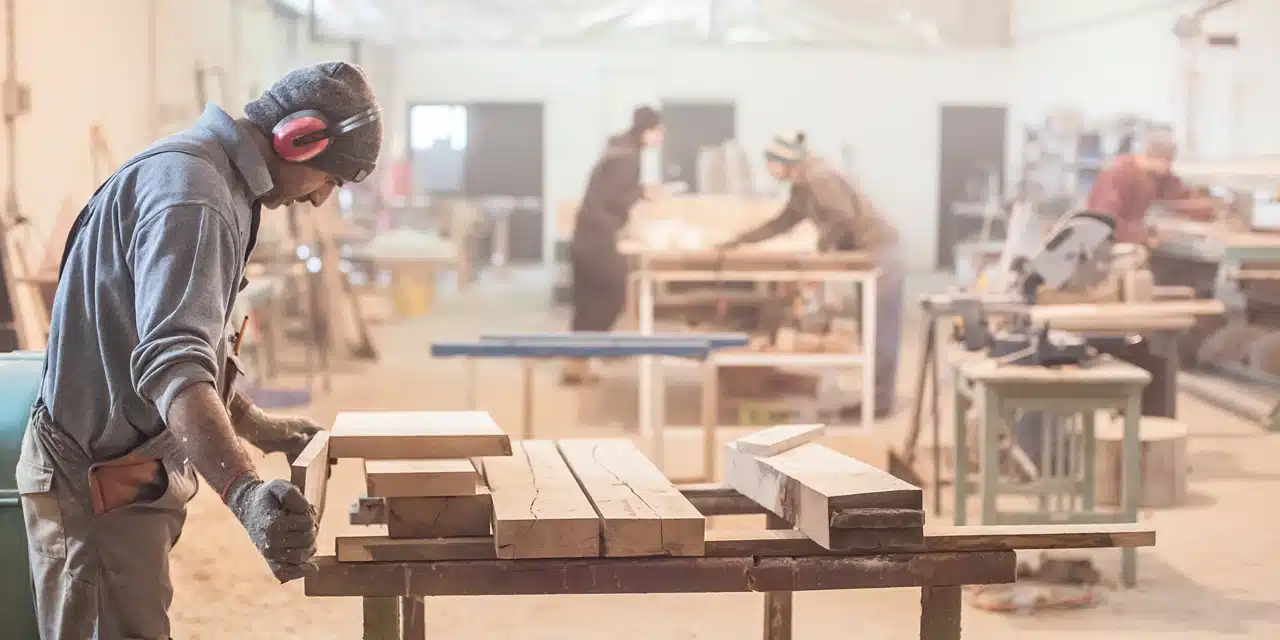
From the first sanding machine, the workshop has its own hazard, and Suva is explicit about it: the exposure limit for airborne wood dust is 2 mg/m³. Sanding and milling regularly exceed it without extraction at source. Suva describes beech, oak and some tropical woods as carcinogenic, with a higher risk of cancer of the nasal cavity and sinuses for people who inhale their dust often.
The practical consequences are a shopping list. Vacuum cleaners of dust class H are needed for beech and oak. FFP2 masks cover ordinary dusty work; FFP3 masks are needed for carcinogenic species. Older extractors with the fan in the raw-air section are no longer state of the art, and for carcinogenic dust Suva says they are no longer permitted. These limits are prevention values that Suva publishes and updates each year on the basis of the Accident Prevention Ordinance, as SECO explains.
The Timber Trade Ordinance and the wood declaration
Two separate timber rules reach a wood business: one at purchase, one at sale. The Environmental Protection Act bans placing on the market for the first time timber that was not harvested or traded in line with the rules of its country of origin (Art. 35e) and requires anyone who does so to exercise due care (Art. 35f).
Buying: trader or operator?
The Timber Trade Ordinance (OCBo) separates two roles. A joinery that buys its boards and sawn timber from a Swiss merchant is a trader: it documents its suppliers and buyers and keeps those records for five years. A firm that imports wood itself, oak from a French sawmill or tropical hardwood, makes the first placing on the Swiss market and becomes an operator. It must then run a due diligence system: gather information on the species with its common and scientific names, the country of harvest, the quantity, the supplier and the evidence of legality; assess the risk; reduce it. Wood whose risk remains non-negligible may not be placed on the market, and records are kept for five years. The ordinance covers, among others, sawn timber, panels, builders’ joinery and carpentry (heading 4418), wooden furniture and prefabricated timber buildings.
Two points to keep in view. The EU Deforestation Regulation does not apply in Switzerland, as the Federal Office for the Environment (FOEN) confirms, but Swiss firms exporting covered products to the EU fall under it. And a revision of the OCBo, consulted on from 22 April to 13 August 2026, would lighten due diligence for wood already placed on the EU market legally; it is still under way.
Selling: species and origin for solid-wood furniture
The Environmental Protection Act is direct: “Any person who supplies timber or wood products to consumers must declare the type of timber and its origin” (Art. 35g(2) EPA). The Ordinance on the Declaration of Timber requires the trade name of the wood, a way for the buyer to find its scientific name, and the country where it was harvested. The list of covered products includes furniture and seats whose main components are solid wood; panel furniture, windows and doors are not on it.
For a cabinet maker, the useful provision is Art. 4(3): someone who supplies one-off pieces or small series of no more than 50 items may inform consumers through a commercial document accompanying the offer, listing for each species the countries of origin based on the previous year’s purchases. One page attached to your quotes, updated once a year, settles it. The Federal Consumer Affairs Bureau checks compliance and charges 200 francs an hour for its work when it finds a breach.
Defects law since 2026: furniture, kitchens, roofs
On 1 January 2026, the Code of Obligations changed in favour of construction clients, and a wood business is exposed differently depending on what it delivers. A roof, a fitted window, a staircase or a parquet floor is work on immovable property. A fitted kitchen is movable work integrated into a building. A dining table remains movable work.
| Rule | Free-standing furniture | Fitted kitchen, interior fittings | Roof structure, windows, stairs, parquet |
|---|---|---|---|
| Notice of visible defects | As soon as the ordinary course of business allows (Art. 367(1) CO) | 60 days where its defects cause defects in the building (Art. 367(1bis)(a) CO) | 60 days; any shorter contractual period is void (Art. 367(1bis) CO) |
| Hidden defects | As soon as discovered (Art. 370(3) CO) | 60 days from discovery, on the same condition (Art. 370(4) CO) | 60 days from discovery (Art. 370(4) CO) |
| Limitation period | Two years from acceptance | Five years where its defects cause defects in the building, otherwise two | Five years, which cannot be shortened to the client’s detriment |
| Clause excluding repair | General rules | Void if the defect concerns a construction (Art. 368(2bis) CO) | Void (Art. 368(2bis) CO) |
Code of Obligations, Art. 367 to 371, version in force on 14 October 2026.
Terms such as “defects to be reported within eight days” or “warranty limited to repair at our discretion” no longer hold for building work. Rewrite your general terms by product type rather than applying the 60 days everywhere: the free-standing sideboard keeps the two-year regime. A signed acceptance record for each job fixes the date from which every period runs.
Getting paid: the builders’ lien
The Civil Code gives the carpenter or joiner who works on a building a security that does not depend on the client’s goodwill. It grants a statutory mortgage right for “the claims of tradesmen and building contractors who have supplied labour and materials, or labour alone, for construction or other works […] whether the debtor is the owner of the property, tradesman or building contractor, tenant or any other person with rights to the property” (Art. 837(1)(3) CC).
- Four months: “Application for such entry must be made within four months of completion of the work” (Art. 839(2) CC).
- Tenants: if a tenant ordered the work, the claim is valid only if the owner consented to it (Art. 837(2) CC).
- No waiver: “The beneficiary may not waive such statutory mortgage rights in advance” (Art. 837(3) CC). A clause in a general contractor’s subcontract saying otherwise has no effect.
The lien attaches to the property on which you worked. A cabinet maker who only delivers free-standing furniture should not count on it and needs deposits instead.
Worked case: a German master joiner in Zug
A German Schreinermeister with fifteen years in a Bavarian workshop sets up a GmbH in Zug to make kitchens and fitted interiors, with three employees. Each of the rules above lands on his desk in the first quarter.
- Agreement: Zug is a GAV Schreinergewerbe canton, and kitchen furniture and interior fitting are in its scope. His payroll is built on a 41.5-hour average week, time records kept for five years and a thirteenth monthly wage paid in December.
- Suva: his staff are insured with Suva for the workshop, where they machine wood, and for the fitting on site.
- Timber: he buys his oak directly from a sawmill in Germany. That first delivery into Switzerland makes him an operator under the Timber Trade Ordinance, so he sets up a due diligence file per batch: species, country of harvest, quantity, supplier, evidence of legality. His Swiss panel supplier, by contrast, only makes him a trader for those panels.
- Oak dust: oak is carcinogenic according to Suva, so the workshop gets class H extraction and FFP3 masks.
- Defects: a fitted kitchen is movable work integrated into a building. If a defect in it causes defects in the building, the client has 60 days to report it and five years to claim, so his old German terms with an eight-day notice clause are replaced.
- Sales to private clients: when he sells a solid oak dining table, he attaches to the offer a commercial document listing the species and the countries of origin of his previous year’s purchases, which the 50-piece rule allows.
When a developer delays payment for the kitchens of a residential building, he applies for a builders’ lien within four months of completing the work rather than waiting.
Working in Switzerland from abroad
Many joineries in Germany, France, Austria and Italy fit work in Switzerland before opening a Swiss entity. The Posted Workers Act requires a written notice before each assignment, and work may start only eight days after the notice (Art. 6(1) and (3)). Fitting joinery or timber frames on a Swiss site belongs to the finishing trades of construction, where notice is required whatever the duration of the job (Art. 6(2)(a) Posted Workers Ordinance). Emergencies such as repairs after an accident or a natural disaster allow an earlier start, but not before the day of notice.
The minimum terms of the extended agreement apply to posted workers for the duration of the job (Art. 2 Posted Workers Act): an Alsatian shop fitter working in Basel applies the GAV Schreinergewerbe; a team from Savoy building a roof in Vaud applies the CCT-SOR. Under the CCT-SOR, a subcontractor established abroad also hands the main contractor the declarations required by the Posted Workers Ordinance. Once assignments become regular, a Swiss company is simpler to run than a series of notices.
How to start a carpentry business in Switzerland: company form and bookkeeping
Most wood businesses start as a GmbH and move to an AG when they bid for larger contracts. The capital rules, the steps at the commercial register and the choice between the two are set out in our guide to the incorporation of a company in Switzerland, and our company formation services cover the whole procedure for founders based abroad.
Three bookkeeping habits separate a woodworking business that knows its margins from one that guesses them. Value work in progress at year end, since a kitchen half built in December is an asset. Track deposits and interim invoices job by job. Count timber stock, which ties up cash and, for imported wood, sits next to a due diligence file kept for five years. If your firm also takes on structural work, joint liability for subcontractors, public procurement and the main construction sector agreement are covered in our guide to starting a construction company in Switzerland.
Costly mistakes
- Pricing jobs under the wrong agreement, for example a carpentry team in Zurich paid as joiners.
- Forgetting the early-retirement notice for a new hire in French-speaking Switzerland.
- Importing oak or tropical wood without a due diligence file.
- Selling solid-wood furniture to private clients without declaring species and origin.
- Keeping pre-2026 terms with an eight-day notice period for building work.
- Letting the four-month lien deadline pass while waiting for a promised payment.
- Fitting prefabricated roof elements above 3 m without nets over the whole surface.
FAQ: starting a carpentry business in Switzerland
Do you need a licence to open a carpentry business in Switzerland?
No. No federal text makes joinery, cabinetmaking or carpentry subject to authorisation, and the commercial register requires no diploma. Swiss qualifications exist, such as the four-year federal VET diplomas for joiners and for carpenters, but they matter for wage classes under the collective agreement and for client trust, not for opening the business. Building permits are requested by the property owner.
Which collective agreement applies to joiners and carpenters?
In Fribourg, Geneva, Jura, the Bernese Jura, Neuchâtel, Valais and Vaud, the CCT-SOR covers joinery, cabinetmaking and carpentry alike, with the CCRA-SOR early-retirement scheme, extended until 31 December 2028. Elsewhere, two agreements extended until 31 December 2027 apply: the GAV Schreinergewerbe for joinery and furniture, and the GAV Holzbau for carpentry and timber construction.
Is Suva insurance compulsory?
Yes, for employees. The Federal Accident Insurance Act assigns to Suva both firms that machine wood (Art. 66(1)(e)) and building firms (Art. 66(1)(b)), so a workshop and a carpentry crew are covered either way. Under the CCT-SOR, the employer pays the occupational accident premium.
What must a furniture maker declare when selling solid-wood furniture?
The species of wood and its country of origin, when the furniture goes to a consumer (Art. 35g(2) Environmental Protection Act). For one-off pieces or series of no more than 50 items, a commercial document attached to the offer is enough, listing for each species the countries of origin based on the previous year’s purchases (Art. 4(3) of the Ordinance on the Declaration of Timber).
How long does a client have to report a defect?
Since 1 January 2026, 60 days for work on immovable property such as a roof structure, fitted windows or stairs, and for a fitted kitchen whose defects cause defects in the building; a shorter contractual period is void. Hidden defects must be reported within 60 days of discovery. Free-standing furniture remains under the general rule: notice as soon as possible and a two-year limitation period.
Can a foreign carpentry firm work in Switzerland?
Yes. Because joinery and carpentry on site belong to the finishing trades, each assignment is notified in writing whatever its duration, and work may start only eight days after the notice, except in emergencies. Posted workers receive the minimum terms of the extended agreement in force where they work: the CCT-SOR in French-speaking Switzerland, the GAV Schreinergewerbe or the GAV Holzbau elsewhere.
Sources
- SECO, collective agreements extended by the Federal Council (CCT-SOR, CCRA-SOR, GAV Schreinergewerbe, GAV Holzbau)
- Canton of Geneva, collective agreement for the finishing trades
- Canton of Geneva, CCT or OCIRT attestation for public contracts
- Federal Accident Insurance Act, SR 832.20, Art. 66
- Construction Work Ordinance, SR 832.311.141
- Suva, wood dust: health risks and protective measures
- SECO, occupational exposure limits
- Environmental Protection Act, SR 814.01, Art. 35e to 35g
- Timber Trade Ordinance, SR 814.021
- Ordinance on the Declaration of Timber and Timber Products, SR 944.021
- FOEN, EU Deforestation Regulation and the Swiss timber trade rules
- Construction Products Act, SR 933.0
- VKF/AEAI, consultation on the revised fire protection rules (16 September 2025)
- Code of Obligations, SR 220, Art. 367 to 371
- Civil Code, SR 210, Art. 837 and 839
- Posted Workers Act, SR 823.20
- Posted Workers Ordinance, SR 823.201
- orientation.ch, federal VET diploma for joiners
- orientation.ch, federal VET diploma for carpenters
Conclusion
To start a carpentry business in Switzerland, the diploma is optional and the map is not. Before the first hire, know which box you are in: CCT-SOR with early retirement in French-speaking Switzerland, GAV Schreinergewerbe or GAV Holzbau elsewhere. Before the first oak delivery from abroad, open a due diligence file. Before the first quote to a private client, attach the wood declaration, and before the first building job, rewrite your terms for the 60-day rule and diarise the four-month lien deadline. My Swiss Company, a Swiss Corporate Services Provider with offices in Geneva and Lucerne and a presence in Zug, incorporates and administers trade businesses for founders from more than 20 countries, from the commercial register entry to payroll under the right collective agreement.